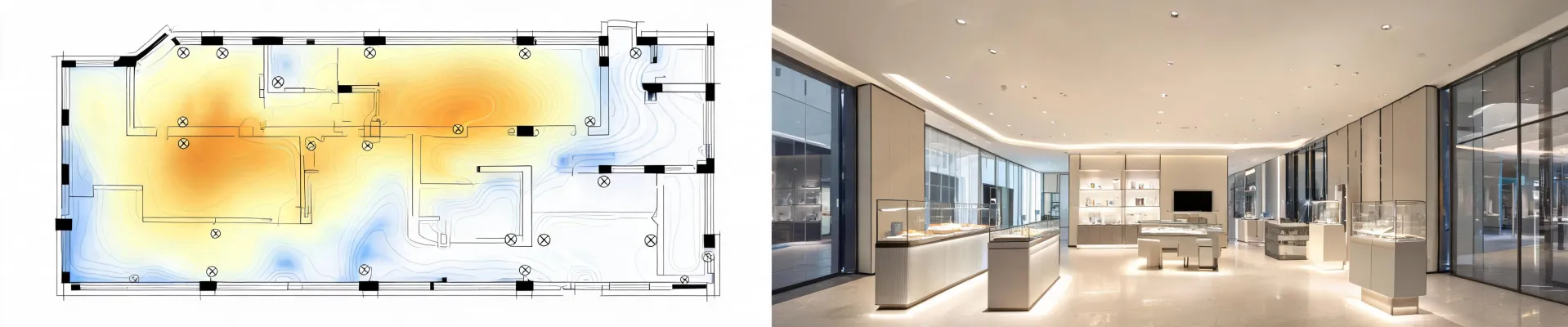
In March 2024, our facilities director walked into my office with a spreadsheet and a problem. We manage three locations—a 120-person office, a 40,000 sq ft warehouse, and a small showroom—and our lighting was a mess. Fluorescent tubes flickering in the warehouse. Downlights in the showroom that hadn't been replaced since 2016. And a maintenance ticket queue that kept growing because half the fixtures used discontinued ballasts.
I'm the office administrator. I manage everything from office supplies to vendor contracts—roughly $340,000 annually across 11 vendors. Lighting wasn't really my wheelhouse. But the facilities director was retiring, and somehow "upgrade the lighting across all locations" landed on my desk.
Starting with the wrong question
My first instinct was to treat this like any other procurement project. Get three quotes, compare unit prices, pick the cheapest one that met specs. I'd done this a hundred times with office furniture and IT equipment.
It's tempting to think you can just compare unit prices. But identical specs from different vendors can result in wildly different outcomes. I didn't understand that yet.
I pulled together a basic requirement sheet: replace all T8 fluorescent tubes with LED equivalents, swap out the downlights, upgrade the warehouse high bays. I sent it to five light fixture distributors we'd worked with before, plus two new ones I found through a trade publication.
The quotes came back within a week. The spread was wild—from $18,400 to $47,000 for what looked like the same scope of work. The cheapest quote was from a distributor we'd used once before for emergency lighting. Their rep promised "equivalent performance at 40% less."
I almost signed it. Should mention: I'd already told finance to expect a mid-$20K expense, and the $18,400 quote made me look like a hero.
Then I asked for the spotlight specification guide and photometric data for the showroom fixtures. That's when things got interesting.
The specification trap
The cheap vendor sent me a one-page PDF. No lumen output data. No color rendering index. No LM-79 or LM-80 test reports. When I pushed, their rep said "it's standard 4000K, 1200 lumens, same as everyone else."
I didn't fully understand the value of detailed specifications until a $3,000 order came back completely wrong—but that's a story from a different project. What I did understand was that "same as everyone else" is not a specification. It's a guess dressed up as confidence.
I reached out to Ledvance through their distributor network. What I got back was a 40-page specification package. Lumens per watt. Color temperature consistency across batches. Dimming compatibility curves. Emergency backup options. Actual test data with dates and lab names.
From the outside, it looks like vendors just need to ship product faster or cheaper. The reality is that for commercial lighting, the specification documentation is the product. Without it, you're buying a box of parts and hoping.
Where the real costs hide
Here's what I didn't factor into my initial spreadsheet: labor.
Our warehouse has 28-foot ceilings. Replacing high bays isn't a swap—it's a scissor lift rental, an electrician's time, and scheduled downtime. If a fixture fails in 18 months because the driver was undersized, I'm not just paying for a replacement fixture. I'm paying for another lift rental and another electrician visit.
The cheap quote used drivers rated for 25,000 hours. The Ledvance high bays we eventually chose were rated for 100,000 hours with a 5-year warranty. The unit price difference was about $34 per fixture. The potential labor difference was closer to $180 per fixture if we had to replace them early.
That math changed everything.
We ended up going with a hybrid approach—Ledvance for the warehouse high bays and downlights where replacement labor was expensive, and a mid-tier option for the showroom track lighting where access was easy and replacement was cheap.
For the showroom, I also added Ledvance smart LED strip under the display shelving. It wasn't in the original scope, but the electrician was already there, and the incremental cost was minimal. That decision paid for itself in the next quarter—our showroom manager said customers actually noticed the displays more.
The unexpected complication
About two months into the project, our HR director asked if we could add grow lights to the office lobby. They wanted to install a living wall—real plants, not the plastic ones—and the existing lighting wasn't going to cut it.
I didn't know anything about Ledvance grow lights before this. I assumed they were for commercial greenhouses or something agricultural. But there are actually options for interior plant installations—full-spectrum LEDs that look like regular lighting but provide the wavelengths plants need.
I wish I had tracked the lead time more carefully. What I can say anecdotally is that the grow light order took about three weeks longer than the standard fixtures. If I'd known that upfront, I would have ordered them with the first shipment instead of as an afterthought.
The living wall became a bigger hit than anyone expected. The HR director got three internal kudos for it. I got a reminder that sometimes the best procurement decisions come from being flexible when the scope changes.
What the industry shift actually means
After five years of managing procurement, I've come to believe that the lighting industry has quietly transformed while a lot of buyers—including me—were still comparing watts and lumens like it's 2015.
What was best practice in 2020 may not apply in 2025. The old model was simple: replace fluorescent with LED, save 50% on energy, done. The new model is about system integration—dimming controls, occupancy sensors, emergency backup, and in some cases, spectral tuning for specific applications.
I can only speak to our situation. We're a mid-sized company with three facilities and predictable operating hours. If you're managing something more complex—a hospital, a manufacturing floor with variable shifts, a retail chain with locations across different climate zones—the calculus might be different.
But the fundamentals haven't changed. Get the specifications in writing. Verify test data. Calculate total cost of ownership, not just unit price. And don't be afraid to ask a light fixture manufacturer for documentation that goes beyond a sell sheet.
What I'd do differently
If I could redo this project, I'd start with the specification requirements instead of the vendor list. I'd build a real comparison matrix that included driver lifespan, warranty terms, replacement lead times, and labor estimates for each fixture type. I'd visit a reference installation—actually put my hands on the product in a real environment instead of looking at photometric curves.
Oh, and I'd budget for the grow lights from day one. That was a $2,800 surprise that could have been a $2,200 planned expense.
The project wrapped in August 2024. We're six months in now. Energy costs are down about 34% across all three locations. Maintenance tickets for lighting have dropped to zero. And I've already been asked to look at a similar upgrade for our satellite office in Q3.
This time, I'm starting with the specification guide.

Clara Whitmore
Clara Whitmore is a lighting photometry and LED source analyst specializing in bulbs, tubes, strips, panels, and integrated luminaires. She interprets IES LM-79 measurements and TM-30 color rendition data through luminous flux, efficacy, intensity distribution, CCT, chromaticity, fidelity, and gamut metrics. She writes evidence-led comparisons for specifiers selecting source formats and luminaires for commercial interiors, industrial spaces, or horticultural systems where measured optical and color performance matter.