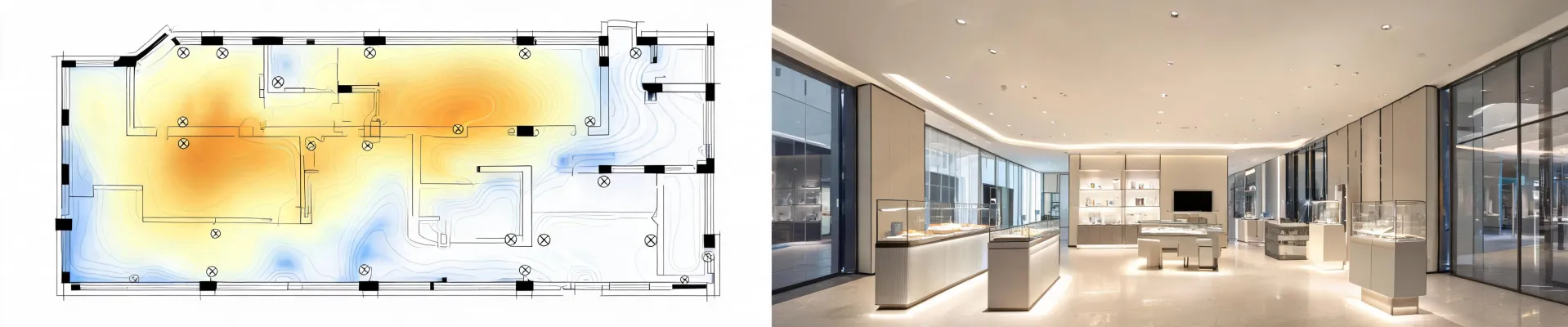
In early 2024, I almost approved a purchase order for 640 LED downlights. That would have been fine if we were only replacing old fixtures. We weren’t. We were relighting a whole office floor with dimmable controls. And I was comparing downlights the same way I compare office paper suppliers: by price per unit.
I should say right away: I’m an office administrator, not a lighting engineer. I manage purchasing for a 400-person company across three locations. That means I own a lot of non-sexy categories—maintenance contracts, furniture, paper, and lighting. I report to operations and finance, and my job is to make sure the order process doesn’t fall apart.
I thought I was comparing fixtures. I was really comparing supply chains.
Most commercial lighting wholesale buyers will probably start the same way I did. Open the quotes, find the cheapest option that meets the basic specs, and try to save a few thousand dollars. For 640 downlights, a $2 difference per unit adds up to $1,280. That matters when finance is watching.
My issue was that the eight quotes I got were not really comparable. Similar-looking fixtures ranged from $8.40 to $13.90 each—about 40 percent between the lowest and highest offer. On paper, they looked the same. The fixtures had similar wattages, similar color temperatures, and similar claims about lifespan. The price gap looked like either a bargain or a rip-off. It was neither. It just represented different amounts of engineering, testing, and documentation buried inside the price.
People think expensive downlights cost more because of the brand label. I think that’s backwards. A brand that wants to sell to wholesale distributors has to pay for driver testing, photometry, certifications, and customer support. Those costs show up in the price. Price isn’t the cause of reliability; it’s usually a sign that someone did extra work before the product reached you.
The deep reasons this decision is hard
Lumens only tell part of the story
The assumption is that more lumens means a brighter room. It does, in a bare lab test. In a real space, “brightness” depends on the beam angle, reflector, mounting height, and even the wall color. I saw a 3,800-lumen fixture create a harsh glare on one side of a conference table, while a 3,200-lumen fixture lit the whole room evenly. The lower-lumen fixture was the better product.
Honestly, I’m not sure why manufacturers still lead with lumens as if it’s the only number that matters. My best guess is that it is easier to print than a full photometric file. If you are evaluating a downlight for wholesale, ask for the IES file. I can’t read photometry like an engineer, but I can see if the vendor can produce it. The ones that can are usually the ones with nothing to hide.
Compatibility is not a footnote
In our project, we wanted dimming in the conference rooms. The product data sheet said the fixture was “dimmable.” That was true, but the driver wasn’t compatible with the Lutron controls already installed in the building. It flickered at lower levels. If we had discovered that after installing 640 fixtures, the fix would have meant replacing drivers or changing control modules. Both are expensive.
For LED strips, the same issue shows up in a different form. A smart LED strip is not just a roll of LEDs; it needs a matching driver and a control protocol. In one part of the renovation, the project architect specified a cove light with the Ledvance smart LED strip. The reason wasn’t brand loyalty. It was that the strip, driver, and dimming controller formed one system with one support contact point instead of three suppliers pointing fingers at each other.
Slim solves one problem but opens another
Slim downlights are attractive because ceiling voids are often shallower than the spec sheet expects. The Ledvance downlight slim line came up early in our search for that reason. But the question wasn’t whether the housing was thin. The question was whether the driver, wiring compartment, and cutout requirements matched the building.
That is where good product documentation earns its keep. The Ledvance downlight slim stayed on our shortlist because the submittal answered those questions before I had to ask. Another “slim” product I looked at had the exact same wording in its brochure but no installation detail or IES file. I did not trust it.
This is also where vendor honesty matters. The rep who walked us through the products pointed to floodlights with an IP rating when I asked about wet areas. He didn’t try to make the downlight a universal solution. A supplier who says this isn’t the right choice for that condition earns trust for the next order.
What a bad downlight choice really costs
Let’s go back to my 640 fixtures. Suppose the lowest quote was $8.40 and the option with better support and documentation was $9.80. The upgrade costs $896 more in total. That seems like a pure waste until you model what can go wrong.
If the cheaper fixture has a 3 percent first-year failure rate instead of 1 percent, that is about 13 extra failed units. Replacing one installed downlight in a finished office isn’t a $10 fix. It takes a lift, maybe two technicians, a replacement product, and disruption. At $150 to $300 per fixture, 13 failures can erase the $896 savings and then some.
The other costs are less visible. In a 2024 project, we waited seven weeks for replacement components because the wholesale supplier didn’t stock the product they sold me. The order invoice was cheap. The delay made me look bad to my VP, and the time cost was far higher than any product saving.
How I choose downlights for wholesale now
I still compare price, but I compare price after three filters:
- Complete spec package. If a vendor won’t or can’t send the datasheet, IES file, installation guide, and compliance documentation, I don’t shortlist them. In commercial lighting wholesale, documentation is part of the product.
- Controls compatibility in writing. Ask if the fixture will work with the exact dimmer, control system, or smart hub in the building. If they refuse to put it on the submittal, I treat that as a red flag.
- Check the range, not just the SKU. One project almost never needs only downlights. We also needed LED strips for coves, spotlights for a retail area, and emergency lighting for corridor exits. When I later searched for spotlight wholesale options, I started with distributors who understood beam angles and trim—not just catalogues sorted by watts.
Ledvance ended up as one of our approved lighting vendors because of range and documentation, not because they were the cheapest on a spreadsheet. They had the downlight slim, smart LED strip, and spotlights in the same catalog, which made cross-order coordination easier.
The best supplier knows their limits
Here’s the part I didn’t expect: the most convincing line in the whole process was a vendor telling me what they didn't do. One supplier said they didn’t have the controls expertise we needed, and recommended a lighting controls specialist. They lost that part of the order, but earned the right to quote the rest. That is the same standard I now apply to lighting brands. I don’t want someone who can “supply everything.” I want someone who knows what their product family is good at—and says so when it isn’t.
So if you’re asking how to choose downlights for wholesale, start by looking past the fixture. Ask which problems the product line solves, what it does not solve, and how the vendor will help you test it in a real room. We didn’t order 640 units from the lowest quote. We ordered a sample batch first, tested them with our actual dimmers, and only then placed the full order. That process cost us two weeks. It also prevented a mistake that would have followed us for years.

Clara Whitmore
Clara Whitmore is a lighting photometry and LED source analyst specializing in bulbs, tubes, strips, panels, and integrated luminaires. She interprets IES LM-79 measurements and TM-30 color rendition data through luminous flux, efficacy, intensity distribution, CCT, chromaticity, fidelity, and gamut metrics. She writes evidence-led comparisons for specifiers selecting source formats and luminaires for commercial interiors, industrial spaces, or horticultural systems where measured optical and color performance matter.