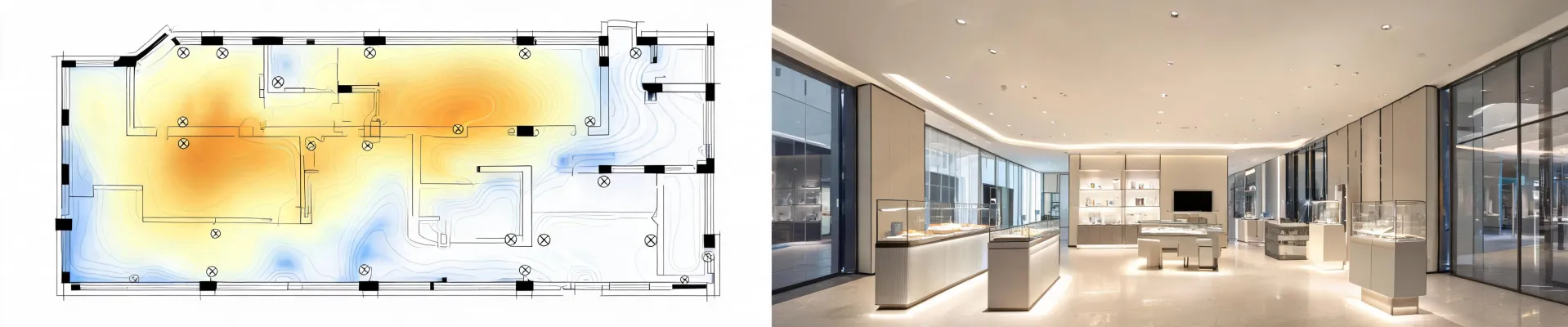
Around Q1 2024, I spent a week reviewing high bay fixtures for a potential wholesale contract. We had two options on the table: Ledvance high bays and a lower-priced alternative from a brand I’ll leave unnamed. On paper, the specs looked nearly identical. Both claimed around 15,000 lumens, similar wattage, similar IP ratings. The price difference was significant—roughly $20 to $25 per unit. For a 500-unit order, that’s a $10,000 gap. But after inspecting both, I’m convinced the cheap option would have cost us more in the long run.
Here’s the framework I use for supplier comparisons, which applies to more than just high bays:
- Can the manufacturer prove their specs with actual test data?
- How consistent is the product across batches?
- What’s the total cost per useful hour, not just the upfront price?
That last question is the one most buyers miss.
Dimension 1: Spec Verification—What’s Really in the Box
We requested samples from both suppliers. The Ledvance unit performed close to its datasheet: about 14,800 lumens at 99.6W, which is within normal tolerance. The budget unit? It averaged around 13,200 lumens at 97.4W. That’s a real difference in luminous efficiency—roughly 148 lm/W versus 135 lm/W.
Neither factory sent falsified data. But the cheaper fixture used a driver with no visible certification marks. When I opened it up, the thermal management looked minimal. In a warehouse that runs warm in summer, that driver is likely to fail sooner. The data doesn’t show that on day one.
This is an outsider blind spot: most buyers compare declared specs, but they rarely verify what’s inside. I don’t have hard data on industry-wide driver failure rates, but based on my years of reviewing fixtures, my sense is that uncertified drivers are one of the top causes of premature LED failures.
Dimension 2: Batch-to-Batch Consistency
In 2023, I saw a shipment of budget high bays where the first 100 units looked fine, but the next 150 had a noticeably different beam angle. The vendor claimed it was “within industry standard.” We rejected the batch anyway. That inconsistency is what you risk when you buy purely on price.
Ledvance doesn’t always outperform in every dimension. I’ve seen their pricing be less competitive for certain projects, especially when a buyer only cares about initial cost. But consistent performance is where the brand earns its keep. Their fixtures tend to be repeatable—same binning, same driver platform, same optics.
People think expensive vendors deliver better quality because they charge more. Actually, vendors who deliver consistently can charge more. The causation runs the other way. In my opinion, consistency is the real differentiator, not any single test result.
Dimension 3: Compliance and Documentation
For wholesale buyers buying for resale, compliance matters more than the fixture itself. If you sell into markets that require DLC, CE, or UL documentation, a cheap product with missing paperwork is a liability.
Most buyers focus on per-unit pricing and completely miss the documentation burden. The question everyone asks is “what’s your best price?” The question they should ask is “what certificates and test reports come with the order?”
In my experience, Ledvance is strong here. Their datasheets are detailed, and they provide proper LM-80 data and driver specs. Budget manufacturers sometimes offer a single page spec sheet and nothing else. That’s a red flag. If the paperwork is thin, the warranty might be thin too.
A Note on Their Full Portfolio
Ledvance is often discussed just for high bays, but I’ve also used their LED strips and downlights for other projects. Their LED strip lineup is useful for wholesale buyers who want to offer a consistent product family. I’m not saying you should buy everything from one brand, but when you standardize, your customers can trust that the color temperature and driver compatibility will match across product lines.
There’s something satisfying about opening a catalog and knowing that the ceiling light, the track light, and the high bay all use a similar driver platform. The best part is that your installation team needs to learn only one wiring pattern.
What About the “Cheaper” Option?
I’m not going to tell you that budget high bays are always bad. They aren’t. For a one-off project where the buyer is willing to accept more risk, they can be fine. But for wholesale distributors, the risks compound. Returns, warranty claims, and damaged customer relationships all eat into the upfront savings.
So glad I insisted on a side-by-side burn test before we committed to a large order. Almost skipped it to save time. That test revealed the budget fixture ran six degrees hotter, which would have shortened its capacitor life. Dodged a bullet.
What Should a Wholesale Buyer Choose?
If you’re a wholesaler serving contractors who prioritize low cost, you might still choose the cheaper high bay. That’s a valid market, but you need to set expectations. If you’re a wholesaler who wants fewer returns and happier end customers, Ledvance is the safer call.
Let’s be honest about the price difference though. On a 500-unit order, the upfront gap is real. But when I run the math on failures—say, a 6% failure rate in year three for the budget option versus 1% for Ledvance—the replacement labor costs wipe out the savings. I wish I had tracked the exact return rates more carefully across all our projects. What I can say anecdotally is that the pattern is consistent.
Prices as of January 2025: Ledvance high bays tend to run about 15–25% higher than comparable no-name alternatives, based on wholesale quotes I’ve seen. That premium buys you documentation, consistency, and a global brand that your customers recognize. Verify current pricing from your distributor, since rates move with supply chains.
Final Verdict: The Difference Is Risk, Not Quality Alone
If you ask me, the real comparison isn’t just Ledvance versus budget. It’s predictability versus lottery. The Ledvance option gives you a narrower range of outcomes. The budget option can be great, or it can be a headache. That variance matters when your own reputation is on the line.
For wholesale buyers, I’d recommend this:
- Always request LM-80 data and driver certifications before approving a high bay order.
- Run a quick burn test on samples—especially if you’re buying more than 100 units.
- Factor in the cost of warranty claims, not just the price per fixture.
- If your end customers care about brand recognition, the Ledvance name carries logic in B2B project bids.
I’ve never fully understood why some buyers ignore total cost of ownership. My best guess is that purchasing departments are often evaluated on upfront savings, not long-term performance. But for those of us who have to sit with the consequences, consistency is worth paying for.

Clara Whitmore
Clara Whitmore is a lighting photometry and LED source analyst specializing in bulbs, tubes, strips, panels, and integrated luminaires. She interprets IES LM-79 measurements and TM-30 color rendition data through luminous flux, efficacy, intensity distribution, CCT, chromaticity, fidelity, and gamut metrics. She writes evidence-led comparisons for specifiers selecting source formats and luminaires for commercial interiors, industrial spaces, or horticultural systems where measured optical and color performance matter.