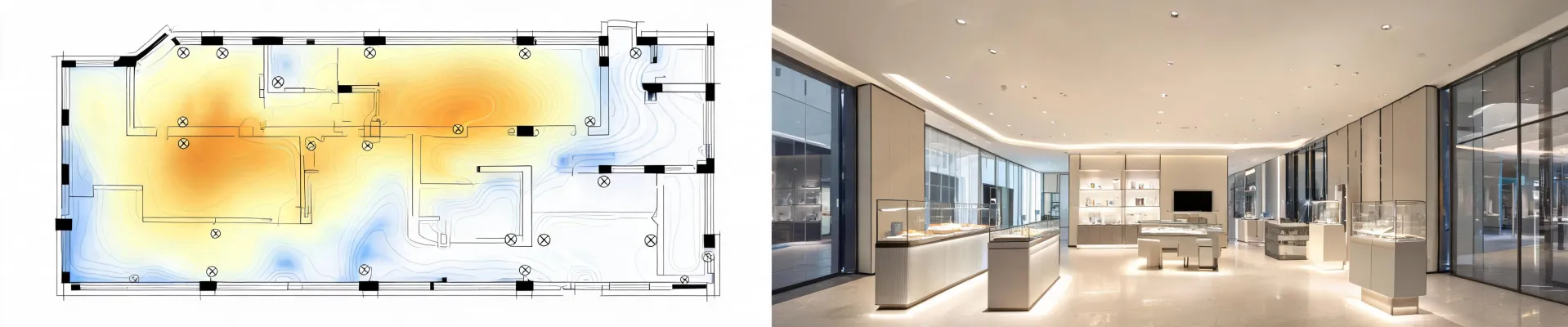
I run procurement for a 30-person electrical distributor. I've managed a lighting budget of roughly $400,000 a year for the last six years, and I've logged every purchase in a cost tracking spreadsheet. My job is simple in theory: get the right fixture to the job site at a price that leaves margin. In practice, it's a maze.
Here's what I know after years of buying downlights, high bays, LED strips, and ceiling fixtures: there is a real difference between building a spec around one full-catalog brand and stitching together a project from whoever has the lowest per-unit price. This is not a brand manifesto. It's a side-by-side comparison.
The comparison framework I use for any lighting buy
Before I look at prices, I put every quote through four filters:
- Catalog completeness: can one supplier cover the whole job?
- Spec and compliance support: are the DLC/UL data and photometric files actually available?
- Total delivered cost: freight, drivers, brackets, restocking fees, and my team's time.
- Warranty accountability: who answers when a fixture fails?
That same framework is the base of every ceiling light distributor buying guide I hand to our sales team. It keeps emotion out of the number.
Catalog completeness: one downlight catalog vs. a folder of PDFs
Most projects are not a single SKU. The warehouse needs high bays. The lobby needs downlights. The new office has cove lighting. The retail area needs track heads.
With multi-brand sourcing, that means collecting cut sheets from four or five suppliers. Sometimes the color temperatures don't match. Sometimes the dimming protocols don't talk to the same controller. (Surprise, surprise.)
With a full catalog, I can spec a Ledvance smart LED strip in the same sitting as the downlight catalog. And when I'm comparing a Ledvance UFO high bay, I can see the matching brackets, drivers, and emergency packs on the same spec page. That doesn't mean every job should be one brand. It means the coordination cost is real, and it's paid in hours.
That's not a fluffy convenience argument. It's a purchasing time argument. If an estimator's time is worth $70 an hour, spending three hours chasing a driver compatibility matrix is $210. On a $4,200 project, that's 5% of the budget before a single box arrives.
Spec and compliance: the paperwork nobody quotes
This is the dimension where buyers get most surprised. Most buyers focus on the price per fixture and completely miss documentation. But if you sell into utility rebate programs or government projects, a missing DLC number can sink the whole invoice.
The question everyone asks is "what's your best price?" The question they should ask is "where are the spec sheets?"
According to Energy Star (energystar.gov, accessed January 2025), certified LED lighting uses at least 75% less energy and lasts up to 25 times longer than incandescent lighting. Rebates, however, are tied to certified models, not LED technology in general.
Multi-brand sourcing often gives you a better unit cost, but the compliance work lands on your desk. You have to request LM-79 reports, verify DLC listings, check markings, and keep everything current for every SKU. A full-catalog supplier has a spec system built for that.
I'll be fair: private-label and OEM products can be perfectly good. But when a manufacturer changes a driver without updating the label, your customer calls you. I've had to redo a complete photometric submittal because a cost-saving fixture didn't match its own datasheet. The redo cost more than the savings. Period.
Price: quote price vs. total delivered cost
Now the numbers. I once compared quotes for a 100-fixture high bay order. One vendor quoted $18,400. Another quoted $16,900. I almost went with the lower quote until I calculated the real total: no mounting brackets, a $3.50 per fixture upcharge for the dimmable driver, and freight on top. The final total was $18,740. The cheap option was $340 more than the expensive option.
That's the transparency problem in a nutshell. A vendor who lists every fee upfront, even if the total looks higher, usually costs less in the end.
I've learned to ask "what's NOT included?" before "what's the price?" Every time.
The same logic applies when I compare a Ledvance UFO high bay against a no-name import. The import can look cheaper per watt. But once I add surge protection, a driver with a real datasheet, and a warranty process that doesn't require shipping back to another continent, the TCO math flips.
Here's the thing: hidden costs are less obvious when you buy from multiple brands. It's not just freight and brackets. It's split shipments, different invoice terms, and mixing sensors from one vendor with downlights from another. When something doesn't work, nobody owns the problem. The worst hidden cost isn't in the price. It's the time spent blaming the other guy.
I recently weighed a $1,200 upfront saving by mixing a cheaper driver brand with a known downlight. The risk was a control system that might not activate the drivers properly. I kept asking myself: is $1,200 worth a building that hums at 3 a.m.? Not a chance.
Look, I'm not saying budget sourcing is always wrong. I'm saying the quote is not the price. It never is.
Stock, lead time, and warranty accountability
In Q2 2024, I waited nine weeks for a stock item from a small private-label supplier. Their customer service answered once, then went quiet. The job site was holding. I substituted a different high bay, and the supplier charged a 15% restocking fee for the order they didn't ship. The optics were bad. The invoice was worse. That one experience changed how I weigh lead time.
Full-catalog brands like Ledvance have distribution depth. That doesn't mean every SKU ships instantly. It means the inventory network is bigger, and if one warehouse is empty, there's usually another location with stock. More important, if a fixture fails, there's one accountability point: the brand.
With multi-brand sourcing, a failed driver becomes a triangle. Fixture manufacturer says it's the driver. Driver manufacturer says it's the fixture. You stand in the middle. That is exactly the kind of risk I now price into every quote.
So which route should you take?
No honest buyer gives a blanket answer. It depends on the project.
- If you're buying 40 identical downlights for a fast remodel and the spec is already locked, multi-brand sourcing can save money. Just add every ancillary cost before you commit.
- If you're a distributor building a ceiling light range, or a contractor mixing downlights, LED strips, high bays, sensors, and emergency lighting, a full-catalog supplier like Ledvance lowers your coordination risk.
- If your customer cares about utility rebates and compliance paperwork, choose a commercial lighting supplier who can hand you one spec package, not an email chain with five ZIP files.
In six years of tracking invoices, projects sourced from one broad-line brand ran about 11% under my internal forecast on average. Mixed-vendor projects ran about 7% over. That's not a promise. It's a pattern, and I trust the pattern.
If I were rewriting this ceiling light distributor buying guide for a new procurement hire, I'd end with one line: buy the product, but buy the accountability behind it. The fixture is on the ceiling. The risk should not be on your desk.
Pricing references above are based on historical quotes for illustration. Verify current rates, lead times, and specifications with your supplier.

Clara Whitmore
Clara Whitmore is a lighting photometry and LED source analyst specializing in bulbs, tubes, strips, panels, and integrated luminaires. She interprets IES LM-79 measurements and TM-30 color rendition data through luminous flux, efficacy, intensity distribution, CCT, chromaticity, fidelity, and gamut metrics. She writes evidence-led comparisons for specifiers selecting source formats and luminaires for commercial interiors, industrial spaces, or horticultural systems where measured optical and color performance matter.