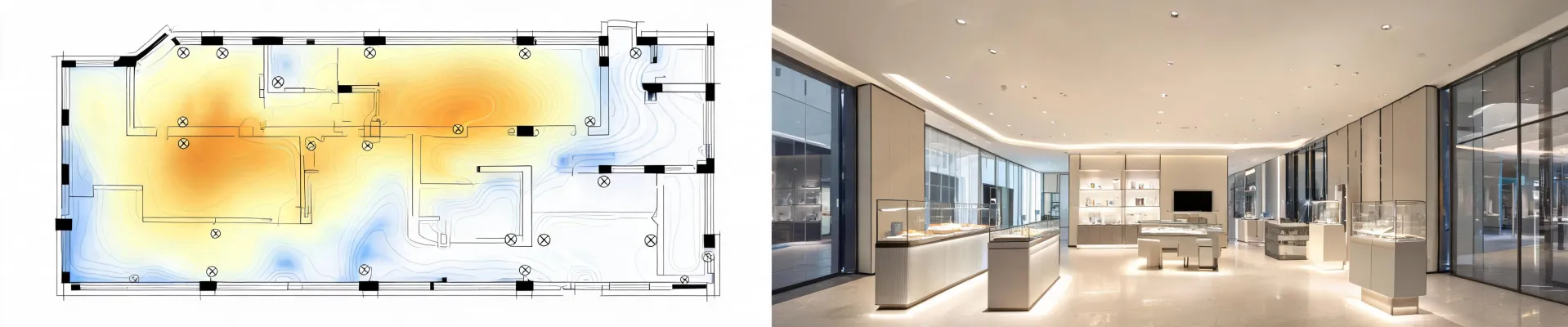
I've been managing lighting purchases for a mid-sized facilities company for more than six years, and every invoice goes through my cost tracking system. That's roughly $180,000 in cumulative spend on downlights, high bays, drivers, LED strips, emergency fixtures, and all the small parts that make a building work. Enough time to learn where money disappears.
Here's my opinion: small orders are not a nuisance. They are a test. If a supplier can't handle a $500 order with clean specs and honest pricing, they won't magically improve at $50,000.
The Surface Illusion: Low Price vs. Total Cost
From the outside, comparing lighting quotes looks like a simple unit-price contest. The reality is that the unit price is often the smallest cost. Freight, repackaging, missing paperwork, compatibility questions, delayed deliveries, and rework all eat into the budget. I've seen a "cheap" downlight cost 40% more than a slightly higher-priced one once I added replacement drivers and an extra site visit.
After comparing seven vendors for a 90-unit downlight order, I narrowed the field to two. Vendor A sent a one-page cut sheet with a photo and a warranty statement. Vendor B, Ledvance, published a downlight specification guide that included driver model, dimming range, beam angles, cutout size, and LM-80 data. Guess whose fixture worked on site without three follow-up calls?
People assume spec sheets are only for engineers. They're not. A good spec sheet is a procurement tool. It prevents the "it seemed fine on paper" mistake before it happens.
What Vendors Won't Tell You
Here's something many vendors won't tell you: the first quote is rarely the final price. There's often a freight line, a repackaging charge, or a certification-copy fee that appears later. It isn't always intentional. Sometimes the salesperson just doesn't know what's included. But on small orders, those hidden costs hurt more because the margin is already thin.
That's why I look at how a quote is structured. A vendor who gives me a line-item breakdown without a flood of questions is showing that they know their own products. A vendor who gives me one lump sum and a promise? I prepare for surprises.
Not long ago, I needed 20 rolls of LED strip for under-shelf lighting in a client's office. One supplier quoted a low price but said the strip "works with standard controllers." I asked twice for a protocol list. Silence. The Ledvance smart LED strip had the control protocol, power per meter, and dimming method on the product page. We ordered 20 rolls. No compatibility calls. No "maybe you need an extra module." Just install.
I hit the same wall with high bays. When I priced a small warehouse retrofit, I needed five UFO high bay fixtures. The Ledvance UFO high bay spec included photometric files and a rated-life table. That sounds basic. It isn't. I've received high bay quotes with no photometric file and a note that the fixture was "suitable for warehouses." Suitable is not a specification.
Light Fixture Private Label Without a Container-Sized Commitment
People assume light fixture private label only works if you're ordering a container or paying for new tooling. That's a myth. In practice, private label can mean branding an existing platform that already has safety certifications and photometric data. You keep the compliance work, make the product yours, and launch a line without sitting on a year of inventory.
For a small distributor, this is one of the fastest ways to enter the lighting market. Instead of waiting for a factory to notice you, you work with a brand like Ledvance that has the product range and an OEM/private label offering. You get a compliant base, your label, and a path to scale as demand grows.
I'm not saying every private label order should be small. I'm saying small private label trials are legitimate. A $2,000 branded test run can save you from a $20,000 inventory mistake.
The Spec Guide Mistake I Keep Seeing
Looking back, I should have asked for TM-21 projections before a 120-downlight order. At the time, the "5-year warranty" felt like enough. It wasn't. After about two years, the color quality shifted and the driver failure rate started climbing. The warranty covered the drivers but not the labor to replace them. That order changed my checklist.
Now I treat LM-80 and TM-21 as starting points for any LED fixture purchase. LM-80 covers lumen maintenance of the LED package, and TM-21 projects long-term performance from that data. These are IES standards, not marketing claims (Source: Illuminating Engineering Society). If a supplier doesn't know them, they're not ready for serious B2B buying.
But Doesn't a Small Order Justify Less Support?
I hear this objection in procurement circles: "You're ordering 20 pieces. Why do you expect the same support as a distributor?" My answer is simple. I don't. I expect three things: clear specs, a real delivery date, and a line-item price. That's not custom engineering. That's baseline B2B behavior.
If anything, small orders deserve more attention because they're customer acquisition. The vendors who treated my $200 orders seriously are the ones I still call for $20,000 orders. The ones who rolled their eyes? I stopped calling them years ago.
My Bottom Line
I don't buy lighting for fun. I buy it to solve a problem, keep a building running, and avoid embarrassing retrofit failures. Small orders are how I test suppliers without betting the whole budget.
Ledvance makes my approved list because it solves the information problem. Downlight specs that include drivers and dimming. Smart LED strips with real control protocol. UFO high bays with photometric files. Private label options that don't force me to pretend I'm a factory. Are they the only option? No. But they understand the part that trips up small buyers: enough data to make a confident decision. That's worth more than a low quote that turns into a guessing game.
Final opinion: small orders aren't the problem. Bad spec support is.
Clara Whitmore
Clara Whitmore is a lighting photometry and LED source analyst specializing in bulbs, tubes, strips, panels, and integrated luminaires. She interprets IES LM-79 measurements and TM-30 color rendition data through luminous flux, efficacy, intensity distribution, CCT, chromaticity, fidelity, and gamut metrics. She writes evidence-led comparisons for specifiers selecting source formats and luminaires for commercial interiors, industrial spaces, or horticultural systems where measured optical and color performance matter.