I’m the office administrator for a 450-person professional services company. I manage all of our facility-related purchasing—lighting included—roughly $200,000 a year across a dozen-plus vendors, and I report to both operations and finance. I’m not an engineer by training. I’ve just become the person who reads spec sheets because nobody else in the building will.
If you ask me, most buyers answer “what to look for in a downlight supplier” in the wrong order. They compare lumens, wattage, CRI, then price per unit. After roughly 200 commercial LED orders since 2021, I’d argue that process discipline matters more: consistency from shipment to shipment, documentation you can actually use, and how little friction it takes to buy from the manufacturer.
The Cost That Never Shows Up on an Invoice
In 2023, we refreshed the main floor. The spec was straightforward: 4000K, 90 CRI, recessed downlights for a drop ceiling. We ordered 340 fixtures from the vendor with the best unit price—or rather, 348, after the change order for the breakroom.
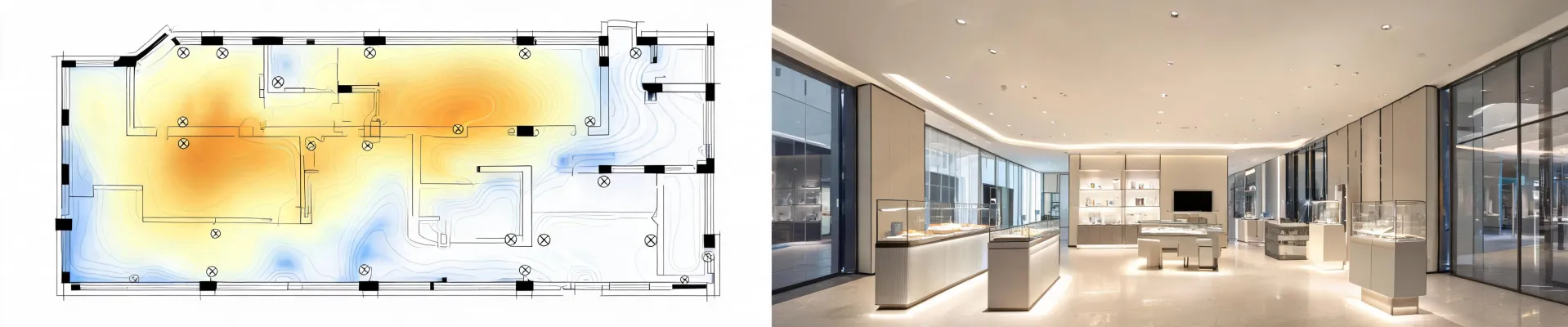
The first delivery looked great. The second delivery, three weeks later, didn’t. It was still labeled 4000K, but next to the first batch it was visibly warmer. Walk into the space and you could see two color temperatures in the same ceiling grid. The office manager asked if the second batch was “the cheap ones.” They weren’t. They were just from a different production run.
When I compared the approved sample with what actually arrived, I finally understood something: a spec sheet is a statement of intent, not proof of consistency. LED fixtures are assembled from components produced at different times and in different lots. Unless the manufacturer controls production runs carefully, a fixture made in March may not match the same model made in June. In bulk commercial lighting, that’s not a technicality. It’s a visual problem you will stare at for years.
A year later, I saw what the opposite approach looks like. We ordered 160 downlights from a different recessed lighting manufacturer, then ordered 60 more about a year later. When the electrician unboxed the second batch, he said the color was a perfect match. The cartons had batch codes, and the manufacturer had locked the LED binning (i.e., sorting chips by output and color before assembly) to the original specification. That didn’t happen by chance. It happened because the manufacturer made it a process priority.
Documentation Is Part of the Product
In 2021, I found a great price from a new downlight supplier—about 18% below our normal source—so I ordered a pallet of recessed fixtures. The fixtures were fine. The invoice wasn’t. It didn’t match the packing slip, the line items were too vague for finance, and the payment got rejected. The supplier kept promising to fix it and then sent the same broken format again. The $2,400 eventually came out of our department budget. Now I verify invoicing and documentation before placing a significant order.
Lighting has its own documentation traps. A UL or ETL listing, a DLC listing if you expect rebate eligibility, a datasheet that matches the actual SKU, warranty terms in writing—all of this is part of what you’re buying. In 2022, one supplier shipped 80 fixtures without the paperwork the local inspector needed. The cartons sat in a staging area while our electrical contractor tried to chase down the certificate, and the contractor billed us for the extra trip. The fixtures were fine. The process wasn’t.
When a manufacturer advertises energy savings or lifetime hours, it should be able to show the evidence behind those claims. Per FTC advertising guidance (ftc.gov), claims have to be truthful and substantiated—so ask for an LM-80 report or the driver specification. If a supplier can’t produce it for a 20-fixture sample, don’t expect it for a 2,000-fixture purchase.
Supplier Efficiency Is Your Efficiency
In 2024, I consolidated purchasing for our three locations. One of the biggest lessons: the efficiency of a supplier’s own operations becomes your efficiency. If we have to call, email, and follow up just to get a quote or confirm stock, that cost is invisible but real.
We moved most repetitive orders to suppliers with online catalogues, clear SKUs, stock visibility, and clean purchase orders. That cut our typical reorder cycle from five days to two and eliminated the data-entry mistakes that used to happen when someone typed a part number from a PDF. I’m not sure of the exact accounting figure—don’t hold me to it—but our AP team stopped spending about six hours a month chasing mismatched POs. Six hours a month is real money, even if it never appears in the lighting budget.
Ledvance shows up on a lot of our purchase orders now, and not because a sales rep took me out to lunch (none has, in case you’re wondering). The catalogue is comprehensive enough that I can find a SKU, a datasheet, and a compatible driver by myself. The Ledvance smart LED strip we used for conference room cove lighting didn’t require a phone call to figure out what controller paired with it. The Ledvance flood light we installed at the loading dock had the IP rating and photometric data in the spec sheet. For anyone buying what I buy, that level of order efficiency is worth more than a slightly lower per-unit price from a supplier that can’t answer an email.
Ledvance isn’t the only manufacturer that works this way. But it’s the one that consistently shortens my process, so it’s the one I keep ordering from.
“Shouldn’t the Contractor Handle This?”
A fair objection: I’m an office administrator, not a lighting specifier, and the electrical contractor should handle all of this. Fair. But in the real world, the building owner owns the problem when fixtures don’t match or documentation holds up an inspection. Contractors don’t absorb that cost out of goodwill—it comes back in change orders. Even if you delegate, you should know whether the supplier you’re using has its act together.
I also want to be honest about the limits of my experience. My sample is narrow: mid-range commercial projects in the U.S., mostly offices and warehouses with standard ceilings, order sizes from 50 to 1,000 fixtures. If you’re doing architectural, hospitality, or highly custom work, your downlight supplier criteria will look different. Some traditional local distributors are outstanding at service, and some digital-first manufacturers are a pain to deal with. This isn’t a “modern good, traditional bad” argument. It’s a “test the process before you scale the order” argument.
The Downlight Supplier Question I’d Ask First
If someone asked me what to look for in a downlight supplier, I’d skip “who has the lowest quote?” and run a trial: order 20 fixtures from the current production batch, ask for the exact paperwork you’ll need for a much larger order, then place a second small order and compare it to the first. You’ll learn more from that process than from any spreadsheet of unit prices.
Unit price still matters. I won’t pretend otherwise; budgets are budgets. But the supplier that controls its batches, documents what it ships, and runs a clean ordering process will almost always be cheaper in total cost than the one with an impressive fixture and a chaotic back office. Great specs are necessary. They just aren’t sufficient.
That’s my opinion after around 200 orders: choose a bulk commercial lighting supplier whose process you can trust, and you’ll spend less time fixing avoidable problems and more time doing the job you were hired to do.

Clara Whitmore
Clara Whitmore is a lighting photometry and LED source analyst specializing in bulbs, tubes, strips, panels, and integrated luminaires. She interprets IES LM-79 measurements and TM-30 color rendition data through luminous flux, efficacy, intensity distribution, CCT, chromaticity, fidelity, and gamut metrics. She writes evidence-led comparisons for specifiers selecting source formats and luminaires for commercial interiors, industrial spaces, or horticultural systems where measured optical and color performance matter.