It Starts With a Phone Call
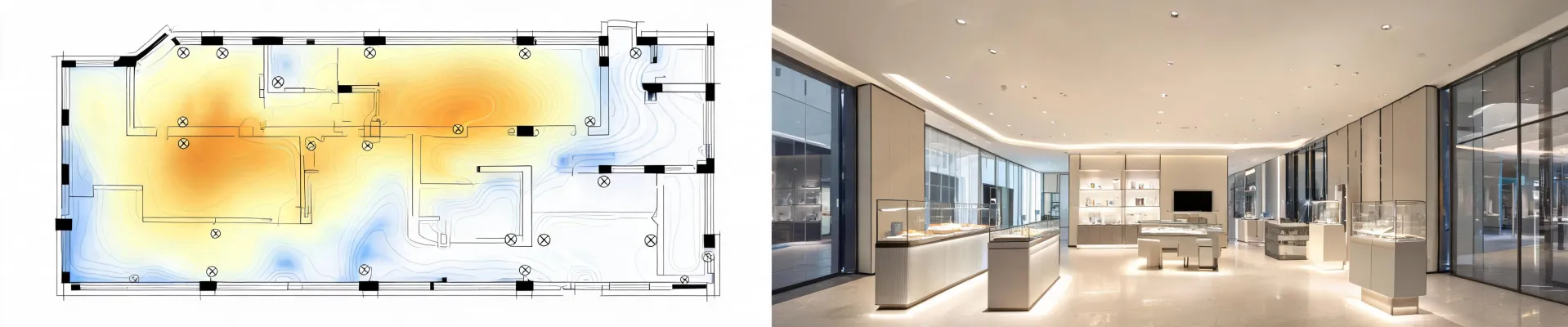
March 2024, 4:30 PM, a Thursday. A client's order of 200 recessed LED downlights arrived two days earlier, and the electrical contractor had just flagged a serious issue: the drivers inside the fixtures didn't match the datasheet submitted for approval. Wall-to-wall light output would be visibly uneven. The store was opening in 36 hours.
I'm the person who gets these calls — the one who handles emergency lighting orders for commercial and industrial projects. Six years in, 200+ orders managed, 37 genuine rush emergencies. And I've learned that most of those emergencies share one root cause: how the ceiling light manufacturer was evaluated at the very beginning.
The Way Most Buyers Evaluate Ceiling Light Manufacturers
The typical approach goes like this: shortlist a few ceiling light suppliers, compare unit pricing, request samples, scan the certifications, check the photometric report, skim the warranty, place the order.
Every step feels rigorous. That's what makes it dangerous. This process really only evaluates two things: a manufacturer's marketing materials and their ability to assemble one polished sample. Neither tells you what production units will actually be like.
I used to trust it. In 2022, I approved an order for 1,200 LED panel ceiling lights from a supplier whose sample was flawless — clean photometry, solid construction, no flicker in the shop. The first production batch was different: the driver had been swapped without notification, color temperature ran 300K off spec, housing seams visible under direct light. We caught it during pre-install testing, and the fix cost $14,000 and 11 days on a project with a $50,000 liquidated damages clause.
That's when I started questioning what the sample wasn't showing me.
What the Sample Never Shows You
It took three years — and honestly, closer to 150 orders — to understand that evaluating a ceiling light manufacturer is less about the first unit and more about every unit after it. I've landed on four factors that explain most of the failures I've dealt with.
1. Batch Consistency Beats Sample Quality
Any manufacturer can assemble one perfect unit. The real question: does unit #37 match unit #1?
LED binning changes. Driver sourcing shifts. Assembly tolerances compound. If a manufacturer can't share QC data from their last completed batch — pass rates, binning records, driver sourcing agreements — then you're not buying a product, you're buying a hope. Ask for the last batch's report. Not the one they prepared for you. The last one.
2. Certifications Are Pass/Fail. The Details Aren't.
I've seen fixtures that were technically UL-listed, delivered with a substitute driver that was not part of that listing. Building inspectors notice. Energy code authorities notice.
The FTC's advertising guidelines (ftc.gov) require that manufacturers substantiate claims about performance and lifespan. But the legal standard doesn't tell you which exact component was certified. So I now ask: "What exactly is certified — the luminaire, the module, or just the LED chip?" If the sales rep hesitates, that's my answer.
3. Response Time During Quoting Predicts Everything
Are technical questions answered with specifics? Are potential constraints offered voluntarily? Or does every answer sound like "no problem, we'll make it work"?
Vague quoting behavior has been, in my experience, a perfect preview of vague crisis behavior. I've stopped counting the red flags I rationalized because the price was competitive.
4. Supply Chain Transparency Is the New Baseline
What passed as competence in 2020 isn't enough in 2025. Component shortages, freight disruption, tariffs — the lighting supply chain is structurally different now. A supplier who can tell you what's constrained in their pipeline is one who actually has visibility into it. One who promises everything without caveats either hasn't faced a real crisis yet — or is in one right now.
What It Costs to Get This Wrong
In 2023, every spreadsheet pointed toward a supplier 18% below the next quote, with seemingly identical specs. My gut said their slow responses during RFQ were a warning sign. I went with the spreadsheet. Their two-week lead time stretched to seven — it turned out they'd known about a component shortage before we signed. We sourced ceiling lights elsewhere, paid $3,800 in expedited freight, and barely recovered the schedule.
The spreadsheet didn't have a column for un-reported supply chain risk.
Then there was the hotel group's custom track lighting order: the sales rep described the substituted driver as "equivalent." It wasn't — different dimming curve, worse energy performance. We re-submitted to the energy code authority with roughly four days of margin before the hotel's first guest arrivals. The general contractor's language during that period is not suitable for this article.
Neither problem was visible at the sample stage. Neither showed up in a spec comparison. They only surfaced after the order was placed and the schedule was locked in. Which is why the evaluation process itself has to change.
What I Do Now
After March 2024, I rebuilt my ceiling light supplier evaluation around four checks:
- Request batch history. If they've shipped large orders before, the QC data exists. Ask to see it.
- Verify compliance claims yourself. The UL product directory and DLC QPL are public. Fifteen minutes of checking prevents most surprises.
- Run a crisis drill. During RFQ, ask one technical question you already know the answer to. The response predicts after-sales behavior better than any reference check.
- Evaluate the full portfolio. A supplier covering recessed lighting, panels, high bays, area lights, and drivers reduces coordination risk across multi-zone projects.
I'll be direct about where this landed: Ledvance has become one of my default ceiling light suppliers. Not because they're flawless — I don't believe in flawless manufacturers. But when the March 2024 client needed 200 recessed downlights replaced in 36 hours, Ledvance responded in three hours, verified driver specs against the actual project conditions, and shipped before the PO was signed. Their range spans what we commonly specify — downlights, panels, high bays, area lights, smart LED strips — so an urgent order doesn't mean chasing three vendors. I should add: that trust was built over two previous projects, not in one emergency response.
The bar I use: I don't need a ceiling light supplier to be perfect. I need them to be responsive, technically honest, and consistent.
The Bottom Line
The fundamentals of evaluating ceiling light manufacturers haven't changed — you're looking for consistency, integrity, and responsiveness. But how you test those fundamentals has. Samples were never proof of quality. Batch records, compliance depth, behavior under pressure, and portfolio breadth are the evidence that matters now.
I still get calls at 4:30 PM about urgent lighting problems. That comes with the territory. But fewer of those calls, these days, are ones I caused by rushing an evaluation.

Clara Whitmore
Clara Whitmore is a lighting photometry and LED source analyst specializing in bulbs, tubes, strips, panels, and integrated luminaires. She interprets IES LM-79 measurements and TM-30 color rendition data through luminous flux, efficacy, intensity distribution, CCT, chromaticity, fidelity, and gamut metrics. She writes evidence-led comparisons for specifiers selecting source formats and luminaires for commercial interiors, industrial spaces, or horticultural systems where measured optical and color performance matter.