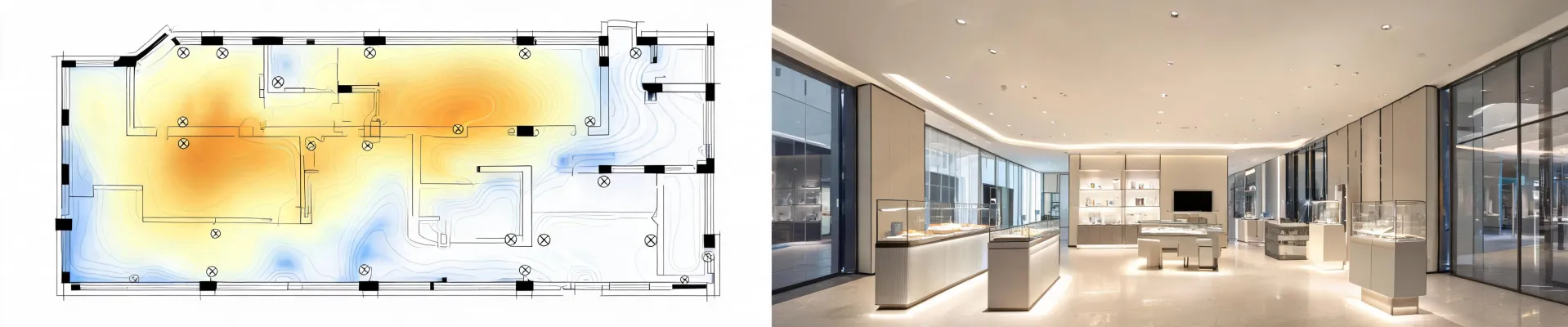
Confession: I coordinate lighting procurement for a mid-sized electrical contractor, and in eight years I've handled roughly 200 rush orders. The one that still bugs me: March 2024, a client called at 4 PM on a Tuesday. Their store opening was 36 hours away—or rather, 33 hours by the time we got on site—and the bulk track lighting order they'd placed with a discount vendor arrived with the wrong heads. Forty of them. We sourced replacements, paid $350 in rush fees on top of the $2,100 order, and an electrician swapped them at 6 AM before the doors opened. It worked. But they'd have been fine if the original spec had been right.
Here's the thing I've learned from those 200 orders: there is no single "best" LED fixture. The right choice depends on your ceiling, your space, how often everything changes, and—the part most people skip—the total cost of installing, running, and maintaining the fixture, not just its price.
This recessed lighting specification guide walks through the three most common commercial lighting scenarios I see on every project. If you can figure out which one you're in, the specification decisions get a lot easier.
The Three Scenarios: A Quick Map
Every lighting project I've worked on falls into one of three buckets:
- Scenario A: Recessed downlights for offices, conference rooms, and corridors. This is the spec-heavy scenario. The fixture becomes part of the ceiling, and rework is expensive.
- Scenario B: Bulk track lighting and LED strips for retail, galleries, and showrooms. This is the flexibility scenario. Displays change, and the light needs to move with them.
- Scenario C: Area lights and high bays for warehouses, industrial spaces, and parking. This is the performance scenario. Long run hours and high mounting heights make efficacy the dominant spec.
If you're asking "which recessed downlight should I spec?" you're probably in Scenario A. If you're asking "how many track heads do I need?" it's Scenario B. If you're comparing 20,000-lumen high bays, it's Scenario C. Simple, right? The details are where it gets tricky.
Scenario A: Recessed Downlights (Rework Is Your Biggest Risk)
When I first started doing lighting specs, I assumed the fixture with the most lumens was the safe pick. "Make it bright" meant max output, end of discussion. After a 2022 project—a 12-foot conference room with 5,000-lumen downlights where the client complained about glare from day one—I changed my mind. Lumens don't equal good light. Distribution, beam angle, and color temperature matter just as much.
IC Rating: Check This Before Anything
IC-rated fixtures can sit in direct contact with insulation. Non-IC fixtures need clearance, typically three inches on all sides. If your ceiling has batt insulation and you spec a non-IC recessed downlight, you're creating a code violation and a fire hazard. The fix at install time means cutting back insulation, moving the fixture, or swapping the whole order. It's a deal-breaker, and it's the first thing I verify on every order. For retrofit work in existing ceilings, an IC-rated fixture gives your installer options—because nobody really knows what's inside a ceiling until it's open.
Driver Access and Junction Box
Everyone told me to check driver access before finalizing a recessed fixture spec. I didn't listen until a 2023 hotel job where a driver failed on a no-name fixture and we had to cut open the finished ceiling to replace it. The drywall repair alone cost more than the fixture. That's when the total-cost lesson stuck. Today I spec fixtures with accessible driver compartments. It's not glamorous, but it's the difference between a $50 repair and a $700 one.
Beam Angle, Spacing, and Color Temperature
For a standard 8-to-10-foot ceiling, narrow-flood beams (40–60 degrees) and fixture spacing around 4–6 feet give even light at the working plane. Tighten the beam for higher ceilings. On color temperature, 4000K works for task areas, but I've watched more than one client swap out 5000K fixtures because the office felt like a hospital. 3000K–3500K is the safe zone for most commercial interiors unless the design calls for something else.
The Standards That Override Everything
Don't finalize a spec before checking the energy code and the rebate list. US projects typically fall under IECC or California Title 24, and if the client wants utility rebates, the fixture needs to be on the DesignLights Consortium (DLC) Qualified Products List. As of early 2025, DLC V5.1 was the version I last saw in effect for most categories—but verify the current version before you spec; these requirements change. You also want fixtures tested to IES LM-79 (photometrics) and LM-80 (lumen maintenance); those test reports are the only reliable way to check whether the published numbers are real. And if the space needs emergency egress lighting per NFPA 101, it typically requires battery backup providing at least 90 minutes of illumination. That's not a later decision. It changes the fixture and the wiring.
One TCO note that applies to all of Scenario A: installation labor usually costs more than the fixture. A fixture from a brand that publishes accurate photometric data—we've used Ledvance downlights on several projects for exactly that reason—is worth the premium over one where the real product doesn't quite match the spec sheet.
Scenario B: Bulk Track Lighting and LED Strips for Changeable Spaces
Retail clients come to me with a different problem: "We need to move the light when the merchandise moves." For that, recessed downlights are the wrong tool. They're holes in the ceiling. The light doesn't move.
Track lighting is the answer. In the US market, track systems come in three formats—H, J, and L—and they're not interchangeable. If you're buying bulk track lighting, the first question is: what track is already on the ceiling, or what is the contractor comfortable installing? Getting this wrong is a red flag moment. You'll be returning the entire run.
Here's where total cost thinking shifts: track lighting costs more per unit than a basic downlight, but the flexibility has real dollar value. Every time the store changes a display wall, your team moves a couple of track heads in twenty minutes—no electrician, no drywall, no re-permitting. Over five years of store resets, that flexibility covers the premium.
Things I now check on every track lighting bulk order:
- Mix the head types. A run that's all flood light looks flat. Combine narrow spots for focal pieces with wider floods for general wash, and the merchandising team will actually use the system.
- Confirm dimming compatibility early. If the store is running a smart control system, the track heads need to talk to it. 0-10V and DALI are the usual suspects; a proprietary ecosystem like Ledvance SMART+ may be involved. Nothing stalls a retrofit like discovering the fixtures don't respond to the controls.
- For coves and accent features, consider an LED strip. A Ledvance SMART+ LED flex strip, for example, gives you color control and a low-profile install that track heads can't match. But be honest about access: a strip hidden in a cove is painful to replace. We install a service loop and keep the driver accessible. We never bury the driver behind a finished wall.
And the one thing I'll push back on: don't buy 200 track heads on price alone. Ask for a sample first. I've seen "compatible" heads that clip in fine but have inconsistent beam angles and visible color variation between units. On a retail ceiling, that's painfully obvious. Test two units side by side before committing the full budget.
Scenario C: Area Lights and High Bays for Big Spaces, Long Hours
Warehouses are a different game. In 2024, a client asked us to replace 200 metal halide high bays at a distribution center. The upfront fixture price was the easy part. The real number was the energy bill: those lights run 5,000+ hours a year.
For high bays and area lights, efficacy (lumens per watt) drives total cost more than any other spec. Let me give you a ballpark. For 100 fixtures producing 15,000 lumens each, running 4,000 hours a year, the difference between 110 lm/W and 130 lm/W is about 8,400 kWh per year—roughly $1,000 at typical commercial rates. Across a 50,000-hour rated life, that's over $12,000. The "cheaper" fixture can easily cost more than the efficient one in the first three years.
Spec priorities I use for high bay and area light projects:
- Match the optic to the mounting height. A UFO high bay with a narrow distribution at 20 feet creates hot spots and dark aisles. At 30 feet, the same optic performs fine. Distribution should be selected after the mounting height is confirmed, not before.
- Design for driver replacement. When a fixture is 30 feet in the air, service labor is a huge cost. I prefer fixtures where the driver can be replaced without unmounting the whole unit. (Should mention: we once ordered a budget high bay that failed at 14 months, and the manufacturer's replacement driver took three weeks to arrive. One whole aisle was dark for that time. The savings weren't worth it.)
- Plan controls from day one. Occupancy sensing and daylight dimming are standard in most energy codes for large spaces. 0-10V is a safe baseline; DALI if the facility has a building management system. Retrofitting controls later costs way more than including them in the fixture spec.
- Check DLC listing for rebates. In many utility territories, a DLC-listed area light or high bay qualifies for per-fixture rebates that cut the effective cost by 15–30%. That's TCO in action.
If you're in this category, Ledvance's area light range covers common configurations—high bays, floodlights, and dedicated area light fixtures—and we've quoted them on several jobs. But the brand matters less than the distribution, efficacy, and driver-access specs you put in the document. Get those right and the project runs itself.
How to Tell Which Scenario You're In
If you're still on the fence, work through these four questions in order:
- What kind of ceiling do you have? Suspended grid with an accessible plenum? Recessed downlights are probably fine. Slab or gypsum with no access? Surface-mounted ceiling lights or track systems avoid cutting into a ceiling you can't open later.
- How much will the space change? Offices, hospitals, and conference centers rarely move their lighting. Retail, gallery, and exhibit spaces do—often seasonally. If the answer is "every few months," track lighting justifies its premium.
- How high is the ceiling, and how long do the lights run? Above 15 feet, or more than 8 hours a day, you're in area light / high bay territory. Efficacy becomes the dominant cost driver.
- What's the real deadline? This is the one that has sunk more projects than any technical spec. If the opening is in four weeks, don't order a custom-color fixture with an eight-week lead time. Confirm stock availability and get a ship date in writing before you promise anything to the client.
One policy we adopted after a 2023 failure—a supplier guaranteed stock, then delayed three weeks, and the client opened without lighting in two back rooms—is the 48-hour rule: we never plan a lighting install with less than 48 hours of buffer between the scheduled delivery and the install date. Last quarter alone, that rule saved us three times.
Build the buffer into the schedule, not the fixture. You can always re-order a fixture if it arrives damaged. You can't re-order a deadline.
The bottom line: determine your scenario, spec for total cost of installation, operation, and maintenance, and keep a delivery buffer. If you're deciding between recessed downlights and track, go back to the ceiling and the client's answer to "how much will this space change?" That will tell you more than any spec sheet.
Clara Whitmore
Clara Whitmore is a lighting photometry and LED source analyst specializing in bulbs, tubes, strips, panels, and integrated luminaires. She interprets IES LM-79 measurements and TM-30 color rendition data through luminous flux, efficacy, intensity distribution, CCT, chromaticity, fidelity, and gamut metrics. She writes evidence-led comparisons for specifiers selecting source formats and luminaires for commercial interiors, industrial spaces, or horticultural systems where measured optical and color performance matter.